Your PEEK Into The Day: 5 Stories That Deserve The Front Page

Peek TV | September 12, 2026
BRICS & Pieces: India’s Big Power Balancing Act
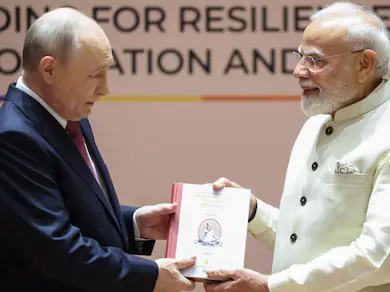
The Fact: The 18th BRICS Summit in New Delhi comes at a moment when the international order is becoming more fragmented, and India is trying to ensure that this fragmentation expands, rather than constricts, its strategic choices. The presence of Russian President Vladimir Putin and Chinese President Xi Jinping in Delhi is therefore significant not simply because two major powers are visiting India at the same time. It brings together three countries that occupy very different positions in India’s foreign-policy calculus, and shows why New Delhi is increasingly trying to work with multiple power centres simultaneously rather than align itself permanently with any one of them. Prime Minister Narendra Modi met Putin on September 11, with discussions covering trade, energy, defence, space, nuclear cooperation, critical minerals, manufacturing and other areas of the bilateral relationship. India and Russia continue to target $100 billion in bilateral trade by 2030. The relationship, however, remains heavily weighted towards energy. Russian crude accounted for 50.83% of India’s total crude imports in July, the highest share on record, although it subsequently fell as Russian discounts narrowed. That dependence explains why Russia remains strategically important to India even as Moscow becomes increasingly close to Beijing. Xi Jinping’s arrival is significant for a different reason. It is his first visit to India since 2019 and comes after the military disengagement along parts of the Line of Actual Control in eastern Ladakh in 2024. Since then, India and China have slowly rebuilt political and economic channels, including the restoration of direct flights and greater movement of businesspeople. But this is not a return to pre-2020 relations. The military deployments have not disappeared, the boundary dispute remains unresolved and China’s relationship with Pakistan remains a strategic concern for India particularly after the 2025 conflict with Pakistan. The two countries continue to have a massive and politically sensitive trade imbalance. India has also remained cautious about Chinese investment in sensitive sectors even as economic ties have begun to recover. The nature of the recent military engagement is revealing. On September 6 and 7, India and China held their first Corps Commander-level talks in the eastern sector at Wacha-Damai in Arunachal Pradesh in a ‘positive direction’. But ‘positive direction’ does not mean strategic trust has been restored. As ORF’s Harsh V. Pant has argued, the expanded BRICS itself is becoming harder to manage because its members increasingly have competing interests. Ahead of the summit, he described the Gulf conflict as the “central fault line” within BRICS and argued that what had appeared to be an achievement — the group’s expansion — could now become a constraint. That is important because BRICS is no longer simply the original grouping of Brazil, Russia, India, China and South Africa. It now has 11 members, including Iran, Saudi Arabia, the UAE, Egypt, Ethiopia and Indonesia, and represents a substantial share of the world’s population and economic output. Its members do not share a single ideology or foreign-policy position. That diversity is actually part of the reason India wants BRICS to survive.
The Context: The easiest way to misunderstand this summit is to see it as evidence that India is moving into a Russia-China camp. The more accurate interpretation is almost the opposite. India is trying to prevent the emergence of a world in which it is forced to choose. China is becoming more powerful; Russia is attempting to preserve its strategic relevance; middle powers such as India, Saudi Arabia, the UAE, Brazil, Indonesia and others are asserting greater autonomy; and the credibility of institutions designed after World War II is increasingly being questioned. For India, this creates both an opportunity and a danger. The opportunity is that a more multipolar world gives New Delhi more diplomatic space. India can work with Washington on technology, defence, investment and the Indo-Pacific; with Russia on energy, defence and nuclear cooperation; with Europe on trade and technology; with Japan and Australia through the Quad; and with China through BRICS, the SCO and bilateral channels. The danger is that multipolarity can also turn into a world dominated by a few very large powers. Foreign Policy Analyst C. Raja Mohan’s warns that India should not confuse multipolarity with anti-American bloc politics. Russia and China themselves use BRICS to expand their strategic options while continuing to preserve room for negotiations with Washington. His argument is that India must approach the changing order with the same realism. In other words, if Moscow and Beijing are practising strategic flexibility, there is little reason for New Delhi to surrender its own. India’s dependence on Russian energy has become enormous. Russian oil gave Indian refiners an alternative to more expensive supplies from other markets, particularly during periods of disruption in West Asia. At the same time, India’s defence inventory has historically been heavily dependent on Russian-origin platforms and systems. So New Delhi’s objective is not to preserve the old India-Russia relationship unchanged. It is to diversify it — towards manufacturing, technology, critical minerals, nuclear energy and other economic sectors — while gradually reducing vulnerabilities created by excessive dependence on any single supplier. The Modi-Putin discussions on September 11 reflected precisely that broader agenda. China presents an even more complicated calculation. India cannot simply “decouple” from China because China is too deeply embedded in Asian and global supply chains. China is India’s largest source of imports, while Indian industry remains dependent on Chinese machinery, electronics, chemicals, components and other inputs. At the same time, India does not want economic interdependence to become strategic dependence. That is why the proposed India-China Strategic Economic Dialogue matters. It is about managing the asymmetry in that relationship — India’s trade deficit, market access, investment restrictions, technology, supply chains and the conditions under which economic engagement can coexist with unresolved security competition. The emerging Indian approach is therefore less “friendship” than managed competition. What about the ‘de-dollarisation’ question? There is enormous attention around the possibility of a BRICS currency. But for India, the more important story is not the creation of a new currency. It is the creation of alternatives to having to use the dollar for every transaction. That is a very different proposition. Russia and China have stronger strategic incentives to reduce dependence on the dollar because both have experienced the vulnerabilities associated with Western financial infrastructure and sanctions. India, however, has little interest in simply replacing dollar dependence with dependence on the Chinese yuan. That is why India’s preferred approach is linking payment systems, encouraging trade in national currencies, improving cross-border settlement mechanisms and potentially connecting Central Bank Digital Currencies.RBI Governor Sanjay Malhotra has explicitly described the objective as making cross-border payments “cheaper, more accessible, safe, secure and fast.” He has also stressed that the purpose is not to replace any currency, but to diversify the system and make it more resilient.
The Peek Insight: India is trying to build a foreign policy in which proximity to one power does not require distance from another. That is increasingly important because the world is not simply becoming multipolar. It is becoming more transactional, more fragmented and more vulnerable to economic coercion. The lesson India has drawn from Russia’s experience is that dependence can become a strategic vulnerability. The lesson it has drawn from China is that economic interdependence does not automatically produce political trust. And the lesson it is drawing from the United States is that even a deep strategic partnership cannot be assumed to remain frictionless. So India is building redundancy into its foreign policy. But there is also a limit to this strategy. India cannot remain permanently in the middle merely by balancing everyone against everyone else. The harder task is to acquire enough economic, technological, military and financial power that India itself becomes one of the poles. That is why the most important question coming out of BRICS may be whether India can turn this diplomatic flexibility into national capability.